Deep Dive · 9 min read · June 1, 2026
The Science Behind Habit Streaks: Why Consecutive Days Actually Work
Whether you've ever killed a workout routine at Day 12 or abandoned a journaling habit after a two-day gap, you already know the sting instinctively — but now behavioral science can explain exactly why it hurts, and why consecutive days are far more powerful than any other frequency. Research confirms that habit streaks tap three distinct neurological and psychological mechanisms — loss aversion, identity reinforcement, and automated neural wiring — making consecutive-day tracking one of the most evidence-backed tools for sustainable behavior change.
- Loss aversion is real and measurable: Losing something feels roughly twice as painful as gaining something feels good, which means a growing streak creates escalating psychological insurance against quitting [5].
- Identity shifts are the deepest change: James Clear's framework from Atomic Habits shows that every logged day is a vote cast for the person you're becoming, not just a task completed [2].
- BJ Fogg's "Shine" effect accelerates wiring: Positive emotion immediately after a behavior — not mere repetition — is what strengthens the neural pathway into automaticity [1].
- 66 days, not 21: University College London research (Lally et al., 2010) found the average habit takes 66 days to feel automatic, with a range of 18 to 254 days depending on complexity [5].
- The Seinfeld Method works visually: Marking each completed day with an X builds a chain whose visual weight makes skipping psychologically costly — by design [3].
- Commitment devices improve outcomes: Ariely and Wertenbroch demonstrated that self-imposed deadlines, which harness loss aversion, outperform complete freedom in sustained performance [4].
| Framework | Creator | Core Mechanism | Best For |
|---|---|---|---|
| Tiny Habits / MAP Model | BJ Fogg | Positive emotion ("Shine") wires neural paths | Starting new habits from scratch |
| Identity-Based Habits | James Clear | Each action votes for your self-image | Long-term consistency and resilience |
| Don't Break the Chain | Jerry Seinfeld (popularized) | Visual streak creates loss-aversion anchor | Daily creative or focus tasks |
| Commitment Devices | Ariely & Wertenbroch | Loss aversion > reward anticipation | High-stakes goal adherence |
| 66-Day Habit Formation | Lally et al., UCL | Neural automaticity through repetition | Measuring realistic habit timelines |
TL;DR: Consecutive-day streaks work because they simultaneously rewire your brain through repetition, reinforce your self-identity through action, and weaponize loss aversion to keep you showing up — all three effects compound the longer your streak runs.
The Neuroscience of Repetition: What Happens Inside Your Brain on Day 2, Day 22, and Day 66
The Neural Pathway That Grows With Every Check-In
Every time you perform a behavior, neurons that fire together wire together. Neuroscience shows that repeated behaviors strengthen neural connections, and each consecutive day makes the habit more automatic, requiring measurably less willpower to execute [5]. Think of it like a hiking trail: the first day you bushwhack through underbrush; by Day 30 the path is worn smooth; by Day 66 you walk it without thinking.
This is why the popular "21-day myth" is so damaging — it sets people up to expect automaticity too soon. Research from University College London (Lally et al., 2010) found the average time for a behavior to feel natural is 66 days, with the range spanning 18 to 254 days depending on the person and the complexity of the behavior [5]. Exercise habits, like daily focus sessions, tend to sit toward the higher end of that range — making a visible streak counter especially valuable as a motivational scaffold during the slow middle stretch.
BJ Fogg's "Shine" Effect: Emotion Is the Glue
Stanford behavioral scientist BJ Fogg spent twenty years researching and coaching more than 40,000 people on habit formation, and his central finding upends conventional wisdom [1]. It is not repetition alone that makes habits stick — it is repetition paired with positive emotion. Fogg calls this emotional reward "Shine," and describes it as the fastest habit-wiring mechanism available because the dopamine released during genuine positive feeling strengthens the neural pathway between trigger, behavior, and reward [1].
This has a direct implication for how you use a streak tracker: the moment you log a completed focus session and see your streak counter tick up, that small visual win should prompt a moment of genuine celebration — not just a mechanical click. Fogg's research shows that genuinely tiny habits anchored to celebration can become automatic in as little as 2–4 weeks of daily repetition, compared with months for habits practiced without positive reinforcement [1].

Why Missing One Day Isn't Fatal — But Missing Two Is Dangerous
Here's a nuance worth knowing: research shows that missing a single day does not materially harm the habit-formation process [5]. The streak is a tool, not a moral contract. What does derail habits is the slide from one miss into two, then three — the behavioral equivalent of a car that rolls back a little, then picks up speed.
This is why the Seinfeld Method's visual framing is psychologically brilliant: each X on the calendar makes the next missed day feel like breaking a physical object, not just skipping a task. The momentum of the visual chain functions as a behavioral commitment device precisely because of what happens when it breaks [3].
James Clear's Identity Layer: Why "Who You Are" Outlasts Willpower
Outcomes, Processes, and Identity — Why Most People Work at the Wrong Level
In Atomic Habits, James Clear introduces a three-layer model of behavior change: outcomes (what you get), processes (what you do), and identity (who you believe you are) [2]. Most goal-setters work only at the outcome layer — "I want to be more productive" — which is the least durable layer. Identity-based habits work from the inside out.
"Your identity emerges out of your habits. Every action is a vote for the type of person you wish to become." — James Clear, Atomic Habits [2]
Clear's framework argues that the most effective behavior change starts with deciding the type of person you want to be, then proving it to yourself with small wins [2]. A freelancer who logs a 25-minute focus session and marks it in a streak tracker isn't just completing a task — they're casting a vote for the identity "I am someone who protects deep work." Enough votes, and the belief becomes self-reinforcing.
The Feedback Loop That Makes Streaks Self-Sustaining
Studies on habit formation show that people are far more likely to persist with challenging behaviors when those actions are tied to important aspects of their identity [2]. This explains a phenomenon that every serious practitioner recognizes: after enough consecutive days, you don't complete the habit because you feel like it — you complete it because skipping would feel like a betrayal of who you are.
This is the key reason a streak counter is more than a vanity metric. It is an objective record of identity votes cast. A 30-day streak tells you, in data, that you have voted 30 times for a particular version of yourself. That evidence compounds. As James Clear frames it, your habits shape your identity, and your identity shapes your habits — a feedback loop that becomes more stable, not less, the longer it runs [2].
Reduced Decision Fatigue: The Hidden Dividend of Consecutive Days
Habits tied to identity require progressively less willpower because you stop debating the decision daily [2]. A freelancer who has a 45-day focus-session streak doesn't ask "should I do deep work today?" any more than they ask "should I brush my teeth?" The consecutive-day structure has moved the behavior out of the prefrontal cortex — where decisions are costly — and into procedural memory, where they're nearly free. This dividend grows every single day the streak continues.
For a deeper look at how to structure these sessions without burning out, the guide on how to build a daily focus habit as a freelancer walks through practical session design alongside the psychological scaffolding that keeps them sustainable.
The Seinfeld Method and Loss Aversion: Your Brain's Built-In Streak Enforcer
How Jerry Seinfeld's Calendar Trick Accidentally Applies Behavioral Economics
The "Don't Break the Chain" method — a productivity strategy popularized under comedian Jerry Seinfeld's name, though he's noted he had no part in its inception — is deceptively simple [3]. You commit to completing one specific daily activity, mark each completed day with a large X on a calendar, and let the growing visual chain do the motivational work. "Your only job is to not break the chain," as the method's core instruction puts it [3].
What makes this so effective isn't the calendar — it's the mechanism underneath: loss aversion. Kahneman and Tversky's foundational research established that losses feel roughly twice as painful as equivalent gains feel good [5]. Once a streak reaches meaningful length, breaking it registers psychologically as a real loss — not just an absence of gain — which is a fundamentally more powerful motivator.
"Streaks also leverage the endowed progress effect and sunk cost psychology, making each consecutive day feel more valuable and harder to abandon." — Domenic Angelino, MS, MPH, CSCS, FitCraft [5]
Ariely, Wertenbroch, and the Commitment Device That Beats Willpower
The behavioral economics research of Dan Ariely and Klaus Wertenbroch provides the academic scaffolding beneath the Seinfeld Method's intuitive design. In their celebrated study, students who were allowed to set their own deadlines for papers — creating self-imposed commitment devices — achieved better results than students given complete freedom [4]. Loss aversion worked in their favor: the pain of potential failure motivated more strongly than the prospect of reward [4].
A habit streak is exactly this kind of commitment device. Every day you log a session, you make tomorrow's skip more costly — not through external punishment but through the psychological weight of what you'd be giving up. This is why the streak counter is not a gimmick: it is an applied behavioral economics tool that converts abstract goal-commitment into a concrete, daily, viscerally felt stake.
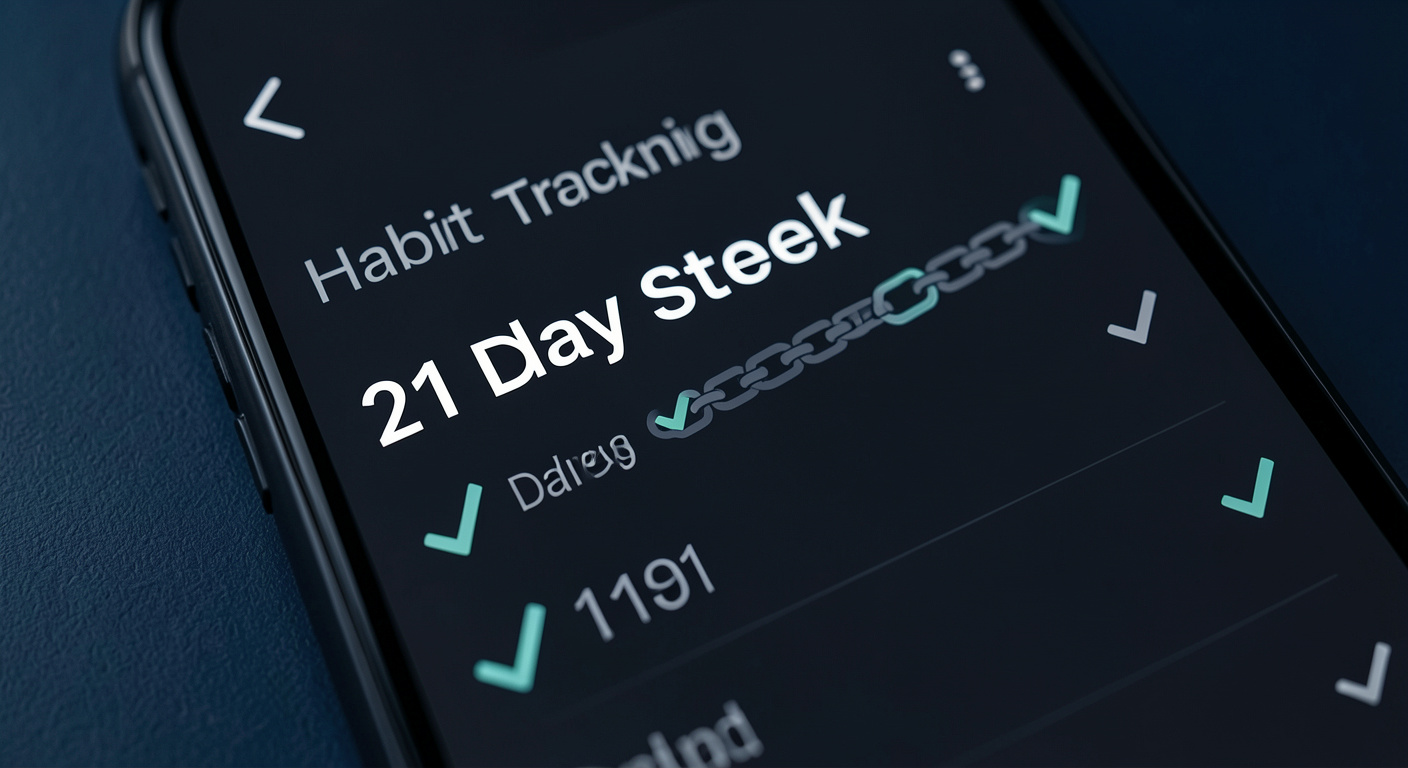
The Endowed Progress Effect: Why Day 5 Feels Different from Day 1
Related to loss aversion is the endowed progress effect — the finding that people who have made progress toward a goal are more motivated to continue than people starting from zero [5]. This is why even a 3-day streak makes Day 4 feel qualitatively different from starting fresh. The streak counter transforms abstract future goals into accumulated present evidence, and loss aversion transforms that evidence into a shield against quitting.
For freelancers specifically, this combination is powerful because self-employment removes the external accountability structures that many workers rely on. A visual streak becomes the accountability infrastructure you have to build yourself — which is exactly why the most effective minimalist habit trackers for freelancers are ones that surface streak data prominently rather than burying it in dashboards.
Putting It All Together: Designing a Streak That Sticks
The Three Rules of a Streak That Compounds
Synthesizing Fogg, Clear, and the behavioral economics literature, the architecture of a durable habit streak has three requirements:
| Rule | Principle Behind It | Practical Application |
|---|---|---|
| Make it tiny enough to be undeniable | Fogg's MAP model: low Motivation × high Ability = reliable behavior | Log even a 5-minute focus session on hard days |
| Attach it to identity language | Clear's identity-based habits: actions vote for self-image | Say "I'm a freelancer who protects deep work" — not "I'm trying to focus more" |
| Make the visual record hard to ignore | Loss aversion + endowed progress effect | Keep streak data front and center, not buried |
Why Streaks Are Especially Powerful for Freelancers
Freelancers operate without the structural rhythms that office environments provide — no commute ritual, no shared lunch break, no physical separation between work and rest. This makes self-imposed daily consistency simultaneously harder and more important than for salaried workers. A streak tracker isn't a nice-to-have for the self-employed; it is a replacement for the external scaffolding that most people take for granted.
The research backs this up: when people can see their consecutive-day progress, they're more likely to persist even through difficult days, because the streak counter shifts the decision from "do I feel like working today?" to "do I want to break a 17-day record?" That reframe — from intrinsic motivation (unreliable) to loss aversion (highly reliable) — is the psychological mechanism that makes consecutive-day tracking a genuinely different tool from weekly or monthly habit goals.
The One Flexibility Rule: Missing One Day Won't Kill You
A final, important caveat from the research: missing a single day does not materially harm the habit-formation process [5]. The psychologically dangerous move is treating one miss as proof of failure and abandoning the habit entirely. Fogg's work emphasizes self-compassion and returning quickly over perfectionism [1]. The Seinfeld Method's extreme framing — "never break the chain" — is motivationally useful but should be understood as a heuristic, not a law. When life intervenes, the goal is to log Day 1 again as quickly as possible.
If you want to see what your accumulated streak data can actually tell you about how your freelance business is trending, the deep-dive on what your focus streak data is actually telling you about your freelance business breaks down how to read patterns in your consistency log as a leading indicator of output and revenue cycles.
The science is clear, the frameworks are proven, and the mechanism is surprisingly simple: show up every day, mark it, and let loss aversion, identity, and neural wiring do the compounding. FocusLog is built specifically for freelancers who want exactly this — a single, distraction-free place to log focus sessions and watch the streak grow. Start your 14-day free trial today and give the behavioral science a chance to work for you.
Frequently asked questions
How many consecutive days does it take to form a habit?▾
Research from University College London (Lally et al., 2010) found the average is 66 days, though the range spans 18 to 254 days depending on the person and the complexity of the behavior. Simple daily habits like logging a focus session tend to form faster than complex physical routines.
Does missing one day in a streak reset all your progress?▾
No. Research shows that a single missed day does not materially harm the habit-formation process. The key is to return to the habit as quickly as possible rather than treating one miss as failure. BJ Fogg's research emphasizes self-compassion over perfectionism in habit building.
What is the 'Don't Break the Chain' method?▾
It's a productivity strategy popularized under Jerry Seinfeld's name. You commit to one daily activity, mark each completed day with an X on a calendar, and let the growing visual chain motivate you not to break the streak. It works by harnessing loss aversion — breaking a long chain feels like a genuine loss, not just a missed gain.
What are identity-based habits and why do they work?▾
Coined by James Clear in Atomic Habits, identity-based habits start with deciding who you want to be, then proving it with small daily actions. Each habit you complete is a 'vote' for your self-image. Studies show people are far more likely to persist with behaviors tied to their identity than behaviors driven by outcomes alone.
Why are habit streaks especially useful for freelancers?▾
Freelancers lack the external accountability structures — commutes, shared offices, scheduled meetings — that help salaried workers maintain rhythms. A streak counter replaces that external scaffolding with self-imposed consistency, and loss aversion makes skipping a day psychologically costly in a way that weekly or monthly goals cannot.
What is BJ Fogg's 'Shine' effect?▾
Fogg's research found that positive emotion immediately after a behavior — not repetition alone — is what wires habits into the brain. He calls this emotional reward 'Shine.' The dopamine released during genuine celebration of a small win strengthens the neural pathway between trigger, behavior, and reward, making the habit more automatic over time.
Sources
- Tiny Habits by BJ Fogg: The Fogg Behavior Model Explained — EasyHabits
- Atomic Habits Summary — James Clear
- Don't Break the Chain: Productivity Workflow Guide — Todoist
- What are commitment devices? Binding future behaviour — Sue Behavioural Design
- The Psychology of Streaks and Habits: Why Streaks Work — FitCraft
- The Identity-Based Habits Blueprint — Moore Momentum
- The Science of Wellness Streaks: How Consistency Transforms Habits — The Wellness Habit
- Don't Break the Chain: Complete Guide to Seinfeld's Method — Asian Efficiency
Keep reading
Ready to see it for yourself?
Back to home →